

The Quiet Distance Between Earth and a Dream
By James Holtzclaw, Interpretive Naturalist
As a child, I stared into the night sky in wonder and amazement at the thousands of stars that looked down on me. These lights were like diamonds, sparkling on a velvet black cloth displayed in a glass case at a museum or jewelry store. Looking back, those youthful moments with the night sky were worth more than any ransom of diamonds, because they represented my first true connection to nature.
My parents recognized and understood my fascination with the sky, so they made a point to nurture it. They took my sister and me to the Space and Rocket Museum in Huntsville, Alabama, and eventually gifted me a Jason refractor telescope for my birthday. One of my favorite childhood photographs shows me sitting on a barrel in my backyard, peering into the eyepiece of that telescope. What was I looking at? A star, a planet, or a comet? Neither. I was spying on the moon.
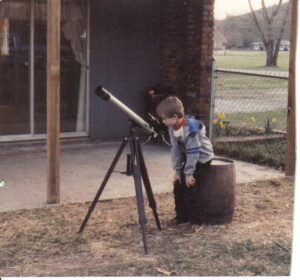
As the afternoon’s light slipped away into the western horizon and the moon revealed itself, I peered at it through my telescope. That instant became the first sacred moment of my life. The moon was no longer a bright disk in the black sky but a place. I saw texture, depth, scars, and history. Now it was part of my history. A memory that could not be erased from my mind.
At that young age, I knew we had been there, stepped on its surface, and planted an American Flag on its grayish landscape. I didn’t know or understand the history of going to the moon. Seeing it as our nearest heavenly neighbor and knowing that we had been there, suddenly the distance between a child in a backyard and the cosmos itself felt smaller. I dreamed that I could one day place my feet on its lunar soil.
Credit: NASA
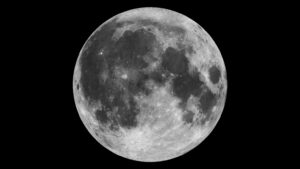
Because of the moon’s orbit, its distance from the Earth is always changing, drifting closer and then farther away. At its nearest, it hovers about 225,000 miles from us, and at its farthest, nearly 250,000 miles. Imagine the Earth as a basketball and the moon as a baseball. Though the moon feels close enough to reach for, the baseball would still rest twenty-four feet from the basketball, suspended in the space between.
That quiet distance took extraordinary courage to cross. What appears gentle through a backyard telescope demanded days of motion, isolation, and faith from NASA’s astronauts, until at last they closed that vast expanse and stood where no human had stood before. We accomplished this feat six times between 1969 and 1972, an astonishing achievement not just for one country, but for all humankind. When I think of that era of space exploration, I am reminded of Wernher von Braun’s words: “The rocket will free man from his remaining chains, the chains of gravity which still tie him to this planet. It will open to him the gates of heaven.”
Credit: NASA
Yet since 1972, the human spirit has reached only the edge of Earth’s atmosphere, through missions conducted by the Space Shuttle and the International Space Station Programs. Still dangerous, still extraordinary, these journeys carried us into Earth orbit to kiss the face of space. But to the public, they slowly became routine, dimming the promise of von Braun’s words. Until now.
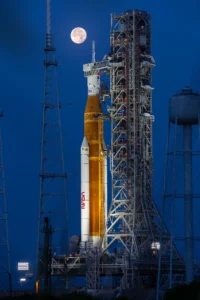
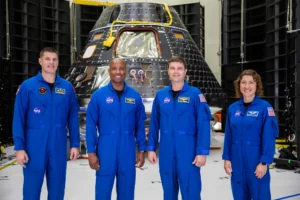
If there are no delays, NASA will send humans back toward the Moon in 2026 through the Artemis program. Like Apollo 8, Artemis II will carry four astronauts around the Moon without landing. This mission will serve as an important step toward a future lunar landing. During the flight, astronauts will test the life support, navigation, communication, and propulsion systems, and confirm that the spacecraft’s heat shield can safely protect the crew during reentry.
What’s even more remarkable is that the crew includes a person of color, a woman, and an international astronaut, inspiring young people from all backgrounds to quite literally reach for the stars while pushing progress toward greater equality. The Moon is not meant for a single group of people, but for all of humankind to explore.
Credit: NASA
If we are lucky, Artemis II will blast off from Cape Canaveral on February 6th, giving us hope once again that we can journey through the vacuum of space and become space-faring explorers for years to come. Will it be easy? No! We know this, but it is for our greater good. I cannot help but think of John F. Kennedy’s famous words, “We choose to go
to the Moon in this decade and do the other things, not because they are easy, but because they are hard.” Artemis II is not just a mission to the Moon, but a declaration that humanity is still willing to risk the unknown, challenge its limits, and reach for something greater.
For the younger me who sat on that wooden barrel, peering through a new telescope at the Moon, this journey is not finished. You will keep looking up, always filled with awe and wonder. You will watch humanity return to the Moon, not just to visit, but to stay. That small backyard moment was never just about curiosity. It was the beginning of a lifelong belief that exploration matters, that distance can be crossed, and that even the quiet dreams of a child can one day echo across the surface of another world.